Tax
Receiving your tax assessment: what you check and what you send us
After filing comes the assessment, in the canton of Zurich as an assessment decision and an assessment order. Compare it with your return and send it…
annyway GmbH · Published: September 2026
Before filing, you reconcile the declared turnover with the books, check the tax rates and document the input tax. Differences can have a good reason. What matters is that you find it and document it.
A VAT return has to follow from the bookkeeping entries. If a transaction sits on the wrong account or a receipt is missing, it often only shows up in the reconciliation before filing. That is exactly why a short check each period pays off.
| Rate | Level | Typical case |
|---|---|---|
| Standard rate | 8.1% | many goods and services |
| Reduced rate | 2.6% | certain food, books or medicines |
| Special rate for accommodation | 3.8% | certain accommodation services |
These rates have applied since 1 January 2024. When rates change, the time of the supply is decisive, not just the date of the invoice. Whether Swiss VAT is owed at all in a given case, and at which rate, depends on the supply.
1. Turnover and books. Compare the turnover recorded in the return with the bookkeeping entries. The amount does not simply have to match the revenue in the income statement. Time of supply, accruals and turnover with different tax treatment can explain a difference. Note the reasons. You need this overview for the annual reconciliation anyway.
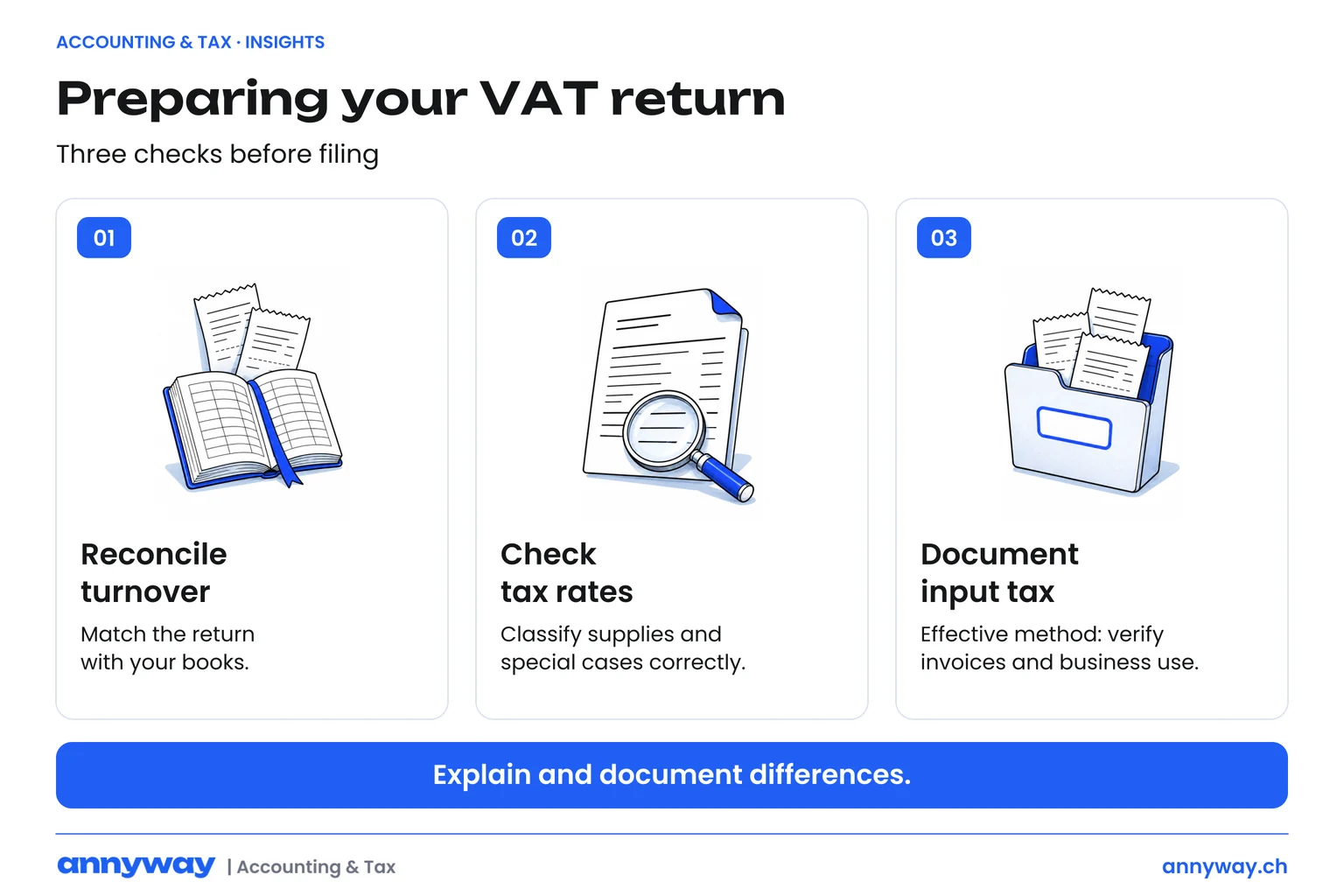 Image created with AI
2. Tax rates and special cases. Take invoices from the different types of turnover: is the rate correct? Are the details on the invoice clear? Are there supplies abroad, turnover exempt from tax, or acquisition tax on services from abroad? Check such cases one by one. A general checklist does not replace their assessment.
3. Input tax and evidence. Compare the input tax deduction claimed with the purchase receipts and the business use. If a detail is missing on an invoice, such as the VAT number, ask for a completed receipt where possible. Under the principle of free assessment of evidence, other meaningful proof can also be relevant. A single missing invoice detail does not automatically mean you can never deduct the input tax. Without sufficient evidence, however, do not simply claim the deduction.
Where business and private use are mixed, it also has to be clarified whether an input tax correction is needed.
With the effective method you set the deductible input tax against the tax owed. With the net tax rate you apply the approved rate to the relevant turnover; there is no separate input tax deduction. Which method is cheaper depends, among other things, on your investments and costs. Check the timing and consequences of a change of method beforehand.
As a rule, the effective method is settled quarterly and the net tax rate half-yearly. Since 2025, eligible businesses can apply to settle annually; conditions and instalment payments apply. For the regular return, filing and payment are generally due within 60 days of the end of the period. An extension for filing does not automatically postpone the consequences of late payment.
If you notice an error, check which period is affected and whether you need a correction statement or the annual reconciliation. Do not quietly adjust the next period.
We prepare and file the VAT return under the chosen method. For the annual accounts we reconcile turnover and input tax and correct differences. Support during a VAT audit is included in the indicative price for the periods we settled ourselves. Tell us about special situations such as supplies abroad so that we can check them. Calculate the indicative price for your mandate.
Tax
After filing comes the assessment, in the canton of Zurich as an assessment decision and an assessment order. Compare it with your return and send it…
Tax
For each property you choose again every year: the flat-rate deduction or the actual costs. Deductible is what preserves the value, not what increases it. For…
Tax
If your GmbH or AG pays you a dividend, it shows up in your private tax return under income and assets. From a 10 per cent…
In a short conversation we clarify what you need and what to expect. Free and without obligation.