Tax
Receiving your tax assessment: what you check and what you send us
After filing comes the assessment, in the canton of Zurich as an assessment decision and an assessment order. Compare it with your return and send it…
annyway GmbH · Published: September 2026
On top of the gross salary come employer contributions for social insurance and occupational pensions. How high they are depends, among other things, on the pension fund plan and the insurance premiums. A worked example shows which figures you need.
You agree a monthly salary of CHF 6’500. For your budget you first need the annual salary and then the contributions your business pays on top. An agreed 13th monthly salary also belongs in this calculation.
A single percentage for every business would be convenient, but not very reliable. For OASI and unemployment insurance the employer shares are fixed. Family compensation fund, accident insurance and pension fund depend on the specific business and insurance plan.
| Item | Employer share | What you need to check |
|---|---|---|
| OASI, DI, IC (AHV, IV, EO) | 5.3% of the relevant salary | Liability to contribute in the individual case |
| Unemployment insurance (ALV) | 1.1% up to CHF 148’200 annual salary | Salary ceiling |
| Family compensation fund | depends on canton and fund | Rate of your fund |
| Occupational accident insurance | depends on policy and activity | Employer premium |
| Non-occupational accident insurance | generally borne by employees | Compulsory from eight hours a week with the same employer; a different split of costs is possible |
| Occupational pension (BVG) | at least half of the contributions | Entry, age and plan of your pension fund |
| Administrative costs of the compensation fund | depends on the fund | Actual rate |
In the occupational pension, the statutory minimum insures part of the salary. In 2026 the entry threshold is CHF 22’680 a year and the coordination deduction CHF 26’460. The statutory retirement credits depend on the age group. Many pension funds insure more than the statutory minimum or split the contributions differently. For your budget, the figures of your fund are therefore what counts.
We calculate with twelve monthly salaries of CHF 6’500, so CHF 78’000 gross a year, and an insured person aged 35 to 44. The rates for the family compensation fund, occupational accidents and administrative costs are assumptions for this example, not rates for your business.
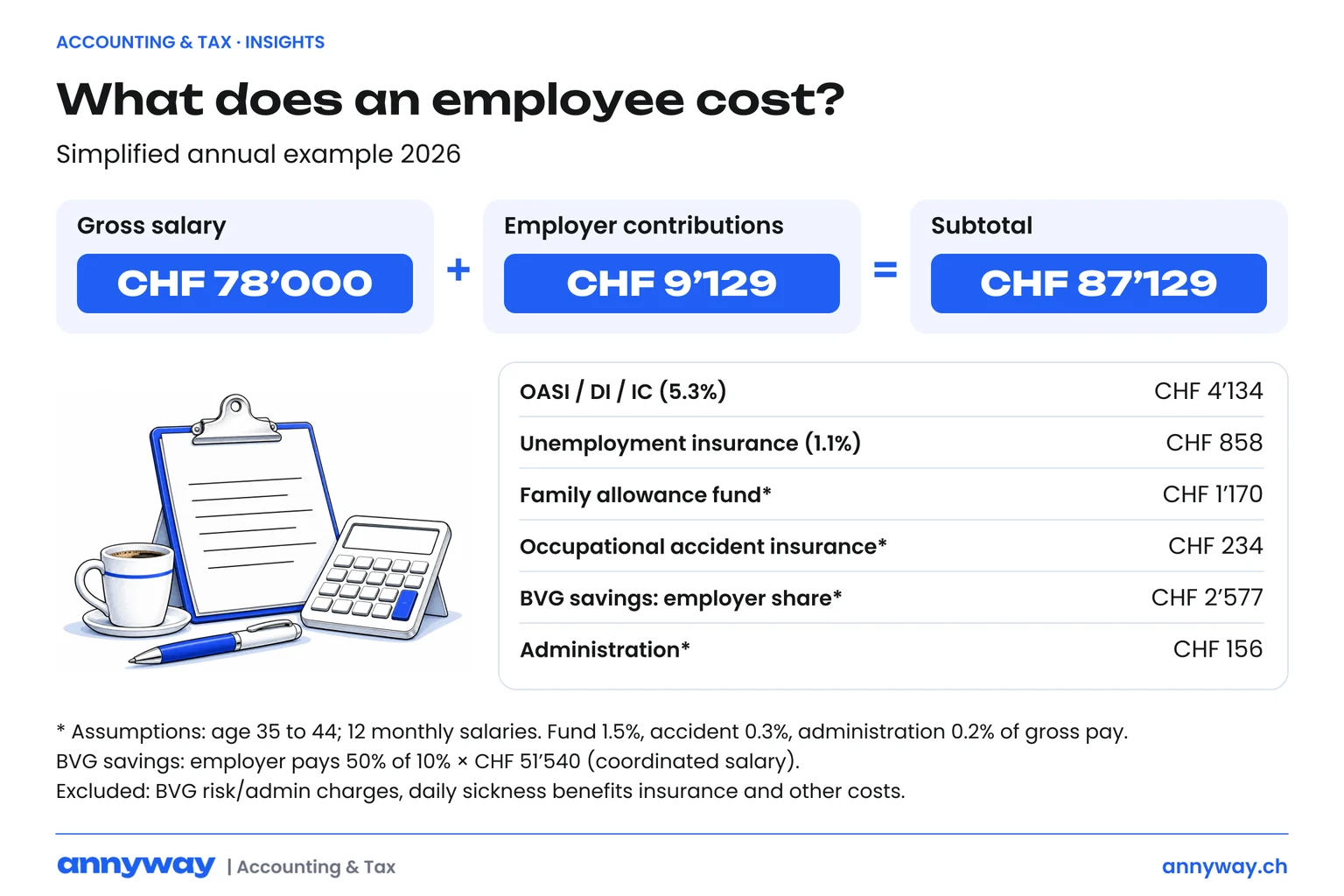 Image created with AI
| Item | Calculation | Employer cost per year |
|---|---|---|
| OASI, DI, IC | 5.3% of CHF 78’000 | CHF 4’134 |
| Unemployment insurance | 1.1% of CHF 78’000 | CHF 858 |
| Family compensation fund, assumed | 1.5% of CHF 78’000 | CHF 1’170 |
| Occupational accidents, assumed | 0.3% of CHF 78’000 | CHF 234 |
| BVG retirement credit, minimum example | 50% of 10% on CHF 51’540 coordinated salary | CHF 2’577 |
| Administrative costs, assumed | 0.2% of CHF 78’000 | CHF 156 |
| Total of the contributions calculated here | CHF 9’129 |
That is 11.7 per cent of the gross salary, or CHF 87’129 a year in total for the items listed here. The calculation does not yet include, for example, additional risk and administrative costs of the pension fund, any daily sickness insurance or a 13th monthly salary. It is therefore not a complete cost estimate for a position.
Holidays are owed even with an hourly wage. A separately shown holiday allowance on the hourly wage is only permitted under certain conditions, for example with irregular assignments. Whether and which public holidays are paid depends, apart from 1 August, among other things on the employment contract and any collective labour agreement. Check the specific rule before you add a surcharge.
Workplace, equipment, software or training can be additional costs. They are not flat-rate payroll costs. And if you agree a 13th monthly salary, the relevant annual salary usually rises with it.
Have ready the gross annual salary including a 13th monthly salary, age, weekly hours, canton and the rates of your compensation fund, accident insurance and pension fund. Our employment cost tool helps with a first estimate. For the actual payroll, the conditions of your business count.
In a payroll mandate we take on the monthly payroll, the notifications for joiners and leavers and the year-end work. The indicative price calculator shows what our payroll mandate costs.
Tax
After filing comes the assessment, in the canton of Zurich as an assessment decision and an assessment order. Compare it with your return and send it…
Tax
For each property you choose again every year: the flat-rate deduction or the actual costs. Deductible is what preserves the value, not what increases it. For…
Tax
If your GmbH or AG pays you a dividend, it shows up in your private tax return under income and assets. From a 10 per cent…
In a short conversation we clarify what you need and what to expect. Free and without obligation.