Tax
Receiving your tax assessment: what you check and what you send us
After filing comes the assessment, in the canton of Zurich as an assessment decision and an assessment order. Compare it with your return and send it…
annyway GmbH · Published: September 2026
Private expenses are not business expenses. If they are paid from the business account, they still have to be recorded correctly. As a sole trader you make withdrawals and contributions visible through the private account. In a GmbH or AG, every payment to you needs a traceable reason.
You pay for a private purchase with the business card. The money is gone, but that does not make the amount a business expense. The books have to show what you paid for and to whom the expense belongs.
For a sole trader and for a GmbH this is not the same transaction. A GmbH has its own assets. That is why it is particularly important to give a clear reason for payments to you and payments on your behalf.
If you pay private expenses from the business account, you record them as a private withdrawal. If you put your own money into the business, it is a private contribution. A private account in the books makes both movements visible.
Three differences matter:
The company has its own assets. A payment to you needs a traceable reason. Four cases come up often:
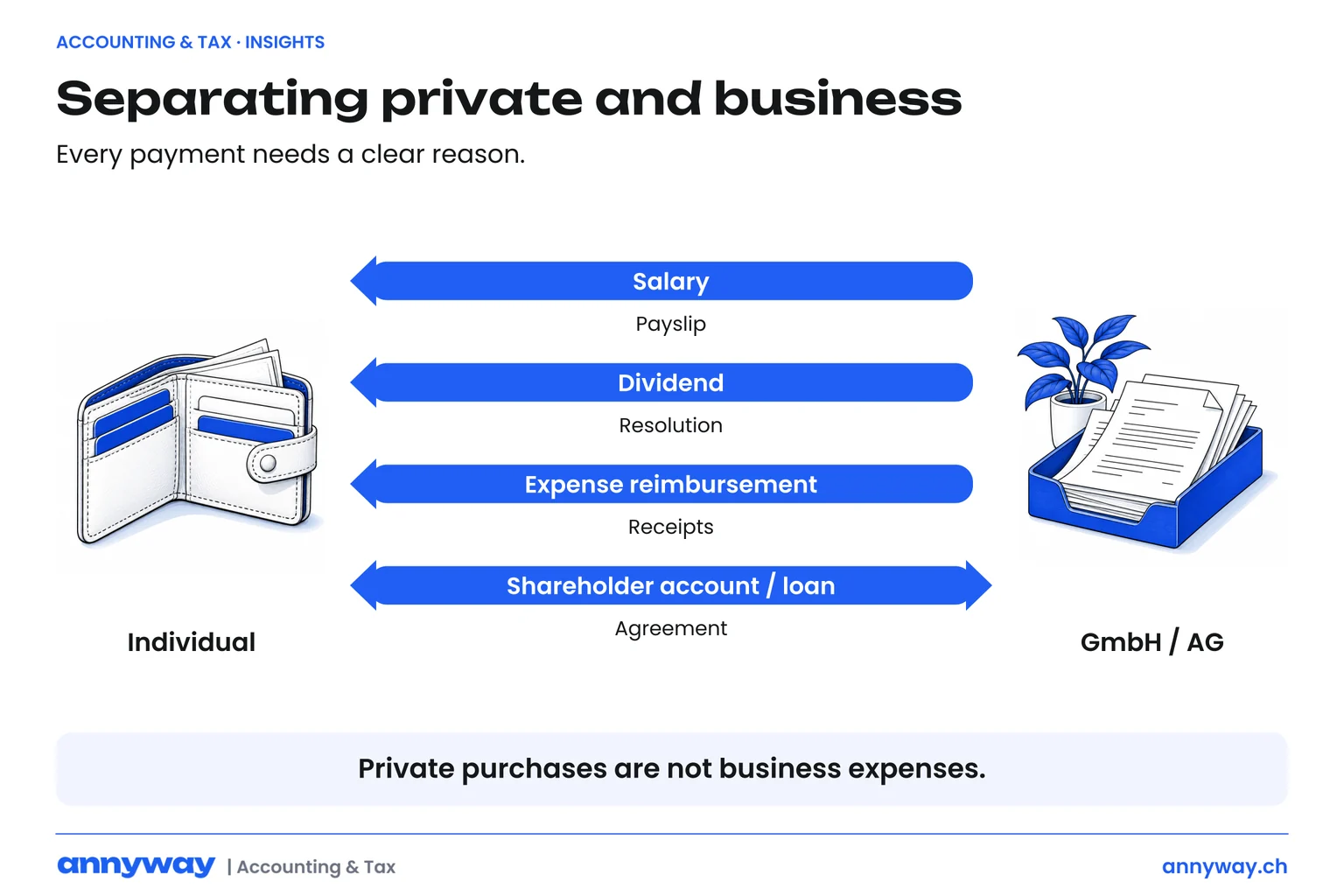 Image created with AI
| Payment | What lies behind it | What to watch |
|---|---|---|
| Salary | Pay for your work | Payslip, social insurance and salary certificate |
| Dividend | Distribution of profit | Resolution of the responsible meeting and withholding tax |
| Expense reimbursement | Repayment of business costs you paid in advance | Business purpose and receipts, or applicable expense regulations |
| Shareholder current account | Clearing account for payments between you and the company | Clarify the balance and the reason for the payments; for loans, check interest and terms |
These are typical cases, not a complete list. Under certain conditions a company can, for example, also repay capital contributions. A transfer from the company account does not become salary, expenses or a dividend just because of how it is labelled.
With a shareholder current account, the first question is worth asking: do you owe the company money, or does the company owe you? For loans to and from shareholders, the Federal Tax Administration distinguishes between minimum and maximum interest rates. Even a small balance is not automatically unproblematic. If private expenses are charged to the company and remain unexplained, a constructive dividend may be at issue. So clarify the entries and the balance before several periods pile up.
A phone contract, a vehicle or a room at home can be used for business and privately. What matters is to justify the business use and to treat the private part appropriately.
If things have got mixed up after all, much can be put right. How much work that takes depends on the receipts and the periods affected.
We sort the entries, clarify private shares and make open balances traceable. For the annual accounts we note which items still need a decision or a receipt. Request a first consultation.
Tax
After filing comes the assessment, in the canton of Zurich as an assessment decision and an assessment order. Compare it with your return and send it…
Tax
For each property you choose again every year: the flat-rate deduction or the actual costs. Deductible is what preserves the value, not what increases it. For…
Tax
If your GmbH or AG pays you a dividend, it shows up in your private tax return under income and assets. From a 10 per cent…
In a short conversation we clarify what you need and what to expect. Free and without obligation.